How to Get Started Keeping Bees (Simple and “Instant” Beekeeping)
*EDIT 1/15/2013* – This post was written when bees were far less expensive than they are now. Unless you are planning to catch a free swarm or have some other cheap bee source, it would be a good idea to learn all you can prior to obtaining bees.
Yeah, that’s right. I did a Valentine’s post on undies followed by one on birds and now I’m talking about bees. What of it?! 
So, let’s learn about bees. There is a lot of beginner beekeeping information out there and this post points to a lot of it. However, my goal is to tell you the most simple way to get started. The “just add water” approach to becoming a beekeeper, as it were.
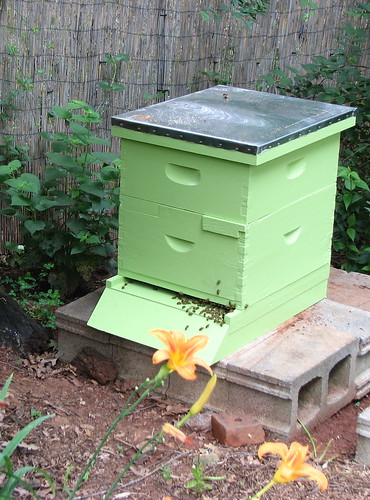
Photo Caption: To avoid alarming my urban neighbors our first beehive was painted green to help it blend in with the garden. We used a light color to prevent the hive from getting too hot. A bamboo screen also shields it from view.
As a beekeeper, you will learn a lot and any preliminary research you do is definitely going to help. But you can own bees, right now, and learn as you go. Here’s how:
- A common “rule of thumb” I’ve heard regarding beekeeping is that it takes more time than a pet cat but less time than a pet dog. This beekeeping calendar estimates how much time you will spend per month with your hive. Check it out and decide if beekeeping really is for you.
- If there is a beekeepers association near you, become a member ASAP! The science of beekeeping can be like drinking from a fire hose. Talking to actual beekeepers and asking questions on a need-to-know basis helps break things down. (But remember that beekeepers are like gardeners — everyone has their own method so you’ll probably hear conflicting points of view). Go to meetings to network and hear the speaking topics, which are usually timed to the seasons. You won’t have to worry as much about when to do certain maintenance steps because your association will clue you in. You may even win free equipment from raffles or door prizes!
- Order some print beekeeping catalogs and thumb through the merchandise to familiarize yourself with it. Don’t worry, you won’t need everything in the catalog. I love Brushy Mountain Bee Farm. They are local to the Appalachians and have excellent quality wooden hive parts. Dadant & Sons and Mann Lake Ltd. are some other good options.
- Consider a subscription to Bee Culture Magazine or read the archives online. The high quality articles will educate you and remind you when to do bee chores.
- Order two or more books on beekeeping. You’ll need them as references (see book list below).
- Take a class! You can often find these through bee clubs or your local Cooperative Extension Service. You don’t have to have bees yet to join.
- Buy a fully functional hive from a local beekeeper and transport it (3 or more miles away) to your house. Sometimes you can get good deals if the hive equipment is older or circumstances demand a quick sale (I got my first hive with a healthy colony of bees in it for only $60 because the sellers were moving out of state). Check Craigslist and ask at the beekeepers association for any leads. Beware of buying a hive with problems, though.
- If you can’t find an established hive you’ll need to start one yourself. Many beekeepers are purists who insist on building and painting their own hives and frames from scratch. You may very well become one of these purists later, but don’t worry about it right now (unless you’re already a whiz at carpentry). Order assembled, painted hive parts — then all you have to do is take them out of the box and stack them on a level surface in your yard! Consider a “beginner’s package” from one of the above catalogs, they are often economical. Here’s all you need as a beginner:
- -Hive (Deep hive body + medium super (or replace the medium super with 2 shallow supers which are lighter weight), bottom board (an IPM bottom board is recommended), inner cover, telescoping cover, queen excluder, and frames with wax foundation — you will need additional supers and frames for honey but you can choose to buy them now or later
- –Bees (order ASAP for spring delivery or learn to catch a free swarm in the spring)
- –Smoker (go ahead and buy the biggest one — beginner beekeepers move slow and the large smokers don’t run out of fuel as fast)
- –Hive tool (looks like a paint scraper but stronger)
- –Veil (you can just wear pants & long sleeves and skip the suit — gloves are up to you, most veterans don’t use them)
You’ll probably accumulate optional gadgets and tools for your beekeeping efforts. Personally, I’d add a bee brush which I find essential when I’m closing up the hive or trying to view frames. I also like having a hive stand with a landing board so I can watch my bees walk into the hive. Fall/winter feeding supplies are seasonally important and long bee gloves are good at least until you get less nervous about handling your bees.
In all, with the deals I found, I think I’ve spent more on a single grocery run than I did on my hive, tools, & suit. Bee equipment is steadily rising in price so you may be looking at several hundred dollars or more depending on where you buy bees and supplies. Check at your beekeepers association, on Ebay, or on Craigslist to see if you can get these items secondhand.
Finally, getting started is important, but learning as much as you can will make you a success. Many of the following books and websites offer differing opinions on beekeeping methods. Research and experience will help you develop a plan that works for you.
At least two books on beekeeping is a good idea. Here are some options:
- The Practical Beekeeper Volumes I – III by Michael Bush uses natural beekeeping methods
- The Backyard Beekeeper: Revised and Updated by Kim Flottum is perfect for urban beekeepers who want to stay on good terms with city and neighbors
- Natural Beekeeping: Organic Approaches to Modern Apiculture by Ross Conrad
- The Beekeepers Handbook by Alphonse Avitabile is one of the most popular beekeeping manuals
- Beekeeping: A Practical Guide by Richard E. Bonney is an easy read
- The Complete Book of Beekeeping by John Drake gives what the title promises
- Beekeeping for Dummies by Howland Blackiston has great info, though I’ve never loved the implication that this series attracts stupid readers
Magazines (Beekeeping is a constantly evolving science and magazines will keep you up to date on the latest research and methods):
Free video tutorials can be found online for the aspiring or growing apiarist. These can help familiarize you with equipment and techniques, but shouldn’t be used to replace other references. Try any of these:
- Essex County Beekeeping Association: Installing a Bee Package in a Hive
- Principals of Beekeeping Series by Jorge Gomez
- Survivalreport: Starting a Hive
- FatBeeMan Series
- Beginner Beekeeping.com
Some of the best info can be found on websites:
- American Beekeeping Federation
- Beekeeping Basics from Mid-Atlantic Apiculture
- Beekeeping Forum on GardenWeb (ask questions!)
- Beekeeping Links by State from Texas A & M
- The Practical Beekeeper Website (tons of free info on natural beekeeping)
- Organic Beekeeping Group (Yahoo email list)
- The Barefoot Beekeeper (sustainable beekeeping, offers an affordable ebook, too)
If you are a beekeeper with advice to “new-bees” I’d love to hear from you. 


21 thoughts on “How to Get Started Keeping Bees (Simple and “Instant” Beekeeping)”
Comments are closed.
Liza - February 17, 2010 6:44 pm
Hey, I’m not a bee keeper, but I love honey! Does that count? I really wanted to say thanks for visiting my site – I love yours! I’ll definitely be checking back, it’s so cute! It’s not like I’m going to forget your name!! Take care!
Sustainahillbilly
Twitter: appalachianfeet
- February 17, 2010 11:40 pm
Sure that counts! I won’t forget your name either, since my regular one is Eliza.
Meredith - February 17, 2010 6:55 pm
Birds, bees, and underwear, huh? You crack me up!
I am *very* interested in beekeeping, but my interest will have to wait until we are in a more stable point in life. Just awaiting hubby’s doctorate degree now, and then we don’t know where we’ll end up, moving on in 7 to 10 months for sure. But I’ll bookmark your excellent article for later, and it wouldn’t hurt to start reading up now using your resource lists. Thanks!
Sustainahillbilly
Twitter: appalachianfeet
- February 17, 2010 11:42 pm
Daydreaming always helps new projects hit the ground running. Good luck with the doctorate and move!
Sandra - February 18, 2010 3:43 pm
Tremendous article on bee keeping; good work. Daddy has kept bees for more than 70 years and my brother has kept bees for 40 years or longer. I take photos of them working bees and it tickles me…I don’t know anyone who wears “bee gear”. I’ve got photos of Daddy and a guy Daddy started bee keeping, they are tending bee hives and both of them wearing bedroom slippers, long pants and goofy smiles. That’s it. No shirts, bee veils, gloves, etc.
I think it’s all to do with attitude; as long as a person isn’t frightened of the bees, the bees will fly around but leave you alone. My brother is allergic to bee stings but they don’t sting him either.
A lot of times there’s grant money to establish new bee keepers.
Sustainahillbilly
Twitter: appalachianfeet
- February 18, 2010 6:38 pm
Haha, beekeeping in bedroom slippers!
Any idea how to apply for the grant money you mentioned? That sounds pretty cool.
Anna - February 18, 2010 7:48 pm
I just wandered over to second Sandra’s info about the grant money. We’ve only had our hives a little less than a year, so I’m not expert on anything except getting started cheaply.
We started four hives for $0 with all new equipment. Our state (Virginia) has a grant meant to promote beekeeping. The money is disbursed through the local extension agents, and in our state at least there’s a distinction made between new beekeepers (who have to pay nothing or very little) and established beekeepers (who get half of their costs reimbursed.) In most of the states I’ve heard about, the grants are similar, with the only addition being that you may be required to take a beginning beekeeper class (which is fun!) Since every state is different, your best bet is to call up your extension agent ASAP because the money goes fast and it’s first come first served!
Sustainahillbilly
Twitter: appalachianfeet
- February 22, 2010 8:19 am
I’ve never heard of a program like that, how exciting! Thanks for letting us know.
Sandra - February 22, 2010 4:17 pm
Just now coming back…I see Anna has responded and as she’s in VA…same state in which I live…I believe grant information may be found through the Farm Service Agency, Extension Cooperative or, perhaps, the Soil and Water Conservation. In VA there are bee keepers associations and they were the ones who knew about the grant money.
You’ll, probably, need to make many, many telephone calls to find the information. Anna’s suggestion to call the
extension agent landed a big ZIP in Tazewell County. Probably, if one called the state Cow College…Anne, that
would be Clemson for you…you’d find the information faster. It’s been my experience the county extension agents
and/or offices are wonderful when it comes to what THEY are interested in but pretty dim when it comes to other
programs. Sad but true.
Sandra - February 22, 2010 4:21 pm
whoops! I’m imprinted and that should have been Eliza Anne…forgive me, please. I hate to say it but that’s probably not the last time I’ll make that mistake. Heck, girl, I’ve known you since before you were a gleam in Glenn’s eye…cut an old woman some slack! -smile-
Sustainahillbilly
Twitter: appalachianfeet
- February 22, 2010 6:22 pm
That’s okay, I’ll answer to either one.
Fortunately, I’m friends with a handful of extension agents and at least one of them is a beekeeper. I’ll see what I can dig up.
Sandra - February 22, 2010 8:31 pm
Your mom has my e-address; please retrieve it from her and send me a PM. I need to respond
to your query re. blogs but want to take it off list. Thanks.
Our extension agent was a cattleman, didn’t cotton to horses, sheep, goats and certainly not bees.
He’s retired and there aren’t any plans to replace him. Unfortunately, a lot/most extension agents
are being diverted to urban folks and their needs while farmers are left out standing in their fields.
Yes, pun intended because I’m a silly cuss.
Darren - March 11, 2010 9:15 pm
I have been toying with starting a beehive, with all the citrus and such. Thanks for some GREAT information and links! I really appreciate it!
Sustainahillbilly
Twitter: appalachianfeet
- March 11, 2010 10:10 pm
You’re welcome! I hope they do your citrus good.
.-= Sustainahillbilly´s last blog ..How to Start a Raised Bed Garden Without Buying Anything (Photo Essay) =-.
Kevin Braun - March 17, 2010 9:01 pm
Just found your blog and am enjoying reading the posts – I am a fellow beekeeper and absolutely love it. I do it for my fun and for my living – hobby and business.
Sustainahillbilly
Twitter: appalachianfeet
- March 19, 2010 4:34 pm
Thanks! Good luck with your ebook.
Jeff Galfione - May 17, 2010 11:35 am
Great Information, thank you !
I’m wondering- how do you protect the hive from ants-with that sugar water and their eventual honey? We have ant issues, here . I so far have used cans of water and oil at the feet of the tables-but ants still seem to be a problem- especially for the young hives.
Thanks!
Jeff
beekeeping supplies
Pingback: How to Set Garden Goals & Go to the Organic Growers School | Appalachian Feet
Tarabetty - January 21, 2013 10:56 am
I was fortunate enough that my bees found me. I have just had the second box installed and am ready my beekeeping for dummies. I dont mind honey but am an avid gardener and my flowers and veggies are happier since my bees set up shop. Thanks for the article.
Sustainahillbilly
Twitter: appalachianfeet
- January 29, 2013 10:12 am
That is very lucky! I was thinking about setting some empty hives out this spring and seeing if anyone moves in.
Jill - January 11, 2014 9:55 pm
Nice post. I am teaching classes in New England for “Beeginning Beekeeping” the info and registration is at http://www.beehomesoon.com It should help those who are thinking about getting started gain the confidence and help them find all the local resources, like hives, bees, and bee schools in our area. Your older post came up on my pinterest board today. We’ve all gotta help the bees!!