How to Grow and Use Amaranth Greens (w/Recipes & Sources)
You can have leafy summer salads in the hot southeast! Though “heat resistant” lettuce only gets you so far into the season before bitterness and bolting set in, you don’t have to go without greens until fall.
Amaranth greens are by far my favorite lettuce substitute. The first time I tasted it I was trying too hard to compare it to lettuce and it wasn’t until my second or third amaranth meal that I began to notice the sweet and nutty undertones in the tender, spinach-textured leaves. The young stems are edible too — they remind me of skinny asparagus.
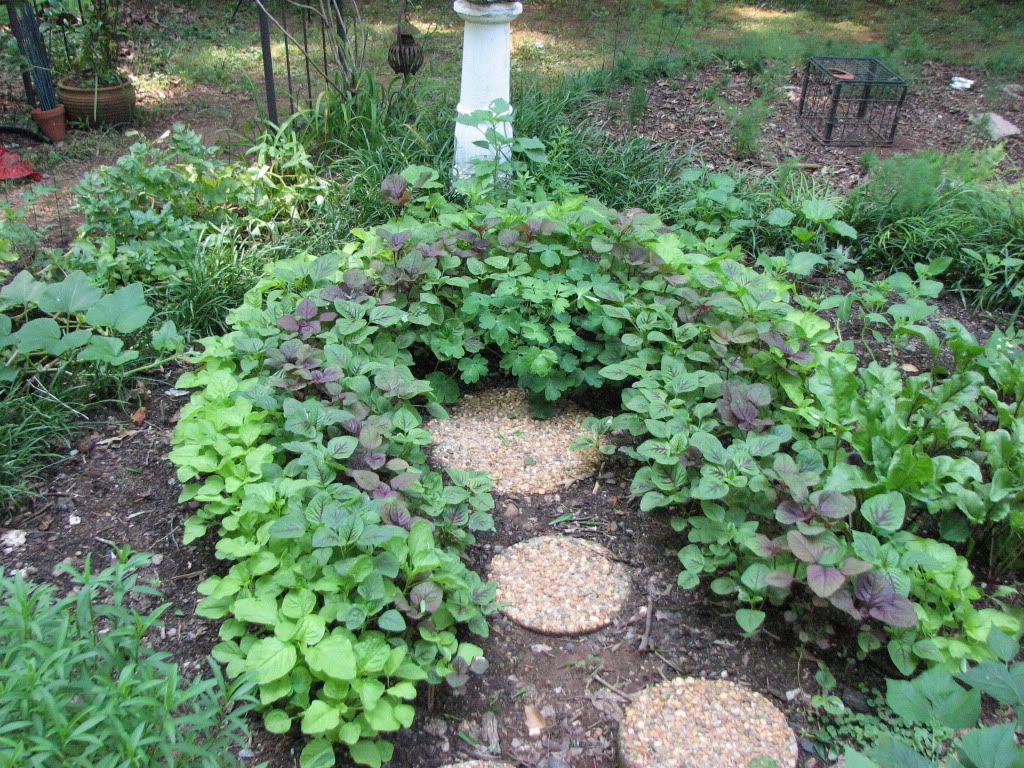
Photo Caption: Different colors of amaranth greens can be grown in patterns to enhance an ornamental edible garden. They continue to look beautiful even when they are being harvested since you only take the top part of the plant. They grow back quickly for nearly unlimited harvesting all summer without ever becoming bitter.
In addition to being a lovely, versatile vegetable (eat them raw or cooked!) they are incredibly easy to grow. The direct-sown seeds germinate even in the sweltering heat, grow rapidly, and are scarcely bothered by pests or diseases. Many people grow amaranth varieties that are used for grain, but fewer people know about the varieties grown for their tasty foliage. This includes varieties of Amaranthus blitum, A. cruentus, A. dubius, A. tricolor, and A. viridis. Some people eat the young shoots of grain amaranths, too.
Get your amaranth green seeds at Asian markets or from mail order catalogs.
Online Sources:
- Evergreen Asian Seeds (8 varieties)
- Kitazawa Seeds (6 varieties)
- Pase Seeds (6 varieties)
- Shaker Heirloom Seeds (1 variety)
- Johnny’s Selected Seeds (1 variety)
- Seeds of Change (1 variety)
I originally picked up a cheap packet of their seeds at a nearby Asian grocery store. You may be able to buy yours locally, too. Make sure to look closely at online amaranth green photos before you go shopping since the paper packets may not be written in English.
You can sow amaranth greens directly into your garden beds any time after your frost free date, they take only 30 days to reach harvest size. Full sun is recommended but I’ve found they’ll grow in shady spots in the south with almost the same vigor. Succession sow a new patch every month of the warm season if you like (warning: this is a prolific veggie — 4′ x 4′ of it nearly overwhelmed my 4 person family last summer). The seeds are tiny so I sprinkle about 3 – 6 seeds every 2 inches (in rows around 3″ apart) and barely cover them up. I don’t bother thinning them later on, it doesn’t seem to matter. Prevent the soil from drying out much until their tops are at least 2″ tall. After that you can irrigate them the way you would any garden vegetable. They’ll tolerate some drought but the most tender greens come from unstressed plants that receive plenty of water.
If you have trouble germinating your amaranth it could be that your soil has formed a hard crust that the small seeds can’t penetrate. This can be particularly problematic in heavy clay. You can avoid this by mixing more compost into the top inch or two of soil just before planting. In wet climates seedlings may disappear as they emerge due to hungry snails and slugs. Use beer traps or an iron phosphate bait product like Escar-Go! to protect them.
Out of all my emerging seedlings I’ve had the least problems with amaranth. It’s so eager to perform in the garden that it can reseed itself and become weedy. Either let it reseed for the following season or avoid weeding by pulling it before the feathery flowers set seed.
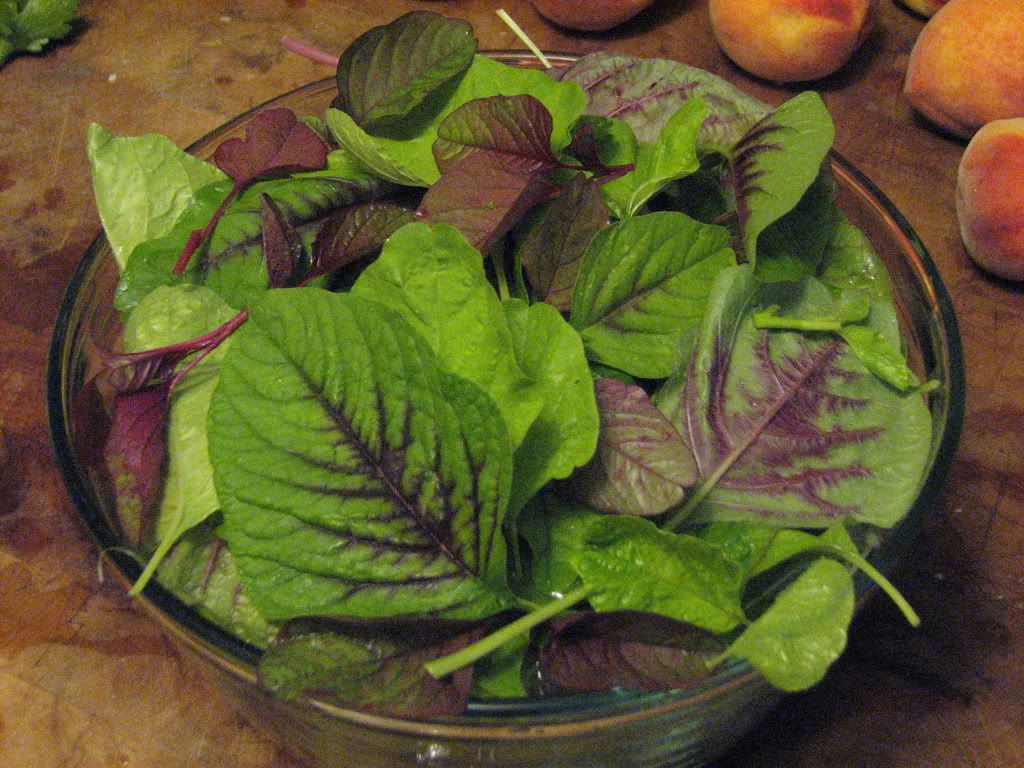
Photo caption: Amaranth greens look as good in the bowl as they do in the garden. Buy several different colors if you'd like to present stunning food centerpieces with minimal work. Just wash them, clip any tough stems, toss, and serve!
I start harvesting amaranth greens when the plants are about 8″ high. Simply cut the small plants just above the first or second set of leaves, taking only the tender tops. They are ready to cut again when they have put out new tender shoots that are 6″ or more long. It doesn’t take any time — harvest often! Once you have harvested the first time you may want to apply a nitrogen-rich slow-release fertilizer.
Using amaranth greens is as simple as washing, tossing, and applying your favorite salad toppings and dressing. Or throw them stems and all into your next stir-fry. Substitute them in any recipe that calls for greens like lettuce, spinach, or kale.
Here’s some recipes to help you use up your bounty of summer greens. If you weren’t able to grow them yourself, try your local Asian grocery store’s produce section.
AMARANTH GREEN RECIPES:
Amaranth Green Salad With Asian Dressing
- A big bowl full of washed, trimmed, and tossed amaranth greens
- Seasonal veggies (like tomatoes, cucumbers, scallions, carrots, celery, zucchini, green beans, etc.) sliced into ribbons or bite-size pieces
- 1/4 cup olive oil
- 1/4 cup soy sauce (can be soy diluted with water if it is strong)
- 3 or more tablespoons of fresh sesame seeds
- 1 – 3 tablespoons toasted sesame seed oil
- 1 – 3 cloves crushed and finely minced raw fresh garlic
- 1 tablespoon (or more) fresh grated ginger
- black pepper to taste
- (optional) 1 – 3 tablespoons finely chopped fresh basil (unusual basil varieties such as Thai, holy, lemon, and licorice are very good in this recipe)
- Mix the greens with the other salad veggies (or simply sprinkle the non-leafy veggies on top).
- Mix the oils, soy sauce, sesame seeds, garlic, ginger, black pepper, and optional basil in a bowl and whisk until emulsified.
- Just before serving pour the dressing over the salad and use clean hands to lightly toss the vegetables until they are thinly coated.
- Serve!
Links to Online Recipes:
- Vegetarian Callaloo Soup on TriniGourmet.com (use amaranth callaloo instead of taro or spinach)*
- Vegetarian Callaloo Soup on EHow.com (use amaranth instead of taro)*
- Callaloo Soup on AllRecipes.com (use amaranth as callaloo)*
- Vleeta on Tobias Cooks! (cooked Greek amaranth greens salad)
- Wilted Vlita with Feta Cheese on Porcini Chronicles (Vlita is a Greek name for amaranth greens)
- Amaranth with Scorthalia on Greek Food Recipes and Reflections (Scorthalia is a traditional garlic sauce)
- Horta Vrasta: Boiled Leafy Green Salad on About.com (Use amaranth greens where it says “dark leafy greens”)
- Sayur Bayam on Indonesian Culinary a la Fie (Use amaranth greens in place of spinach)**
- Fried Bayam on Home Cooked Recipe (Use amaranth greens in place of spinach)**
- Sajor Bayam on YumYum.com (Bayam-Corn Puree — use amaranth greens in place of spinach)**
*Both amaranth greens and taro are referred to and used as “callaloo” and they can be substituted for each other. Callaloo soup is also called Pepperpot Soup. There are other regional recipes referred to as “pepperpot soup” but this is the Creole or Caribbean one.
**”Bayam” is another term for amaranth greens. Most Americanized “bayam” recipes use spinach as an amaranth green substitute. You simply need to reverse the recipe again to use the original amaranth in it.


29 thoughts on “How to Grow and Use Amaranth Greens (w/Recipes & Sources)”
Comments are closed.
tobias cooks! - May 10, 2010 1:25 pm
Thanks for mentioning my recipe. Interesting post on growing Amaranth. We eat it so much, so it is good to know a bit more about it.
Sustainahillbilly
Twitter: appalachianfeet
- May 11, 2010 10:52 am
You’re welcome! I was glad to find such a nice recipe for it online.
.-= Sustainahillbilly´s last blog ..How to Plant Tomatoes (and Get the Best Root System) =-.
Liza - May 10, 2010 4:13 pm
Another intelligent and well-written post. Keep up the good work, Eliza.
.-= Liza´s last blog ..[Monday – Liza’s Plants] Teeny Tiny Birds with Attitude =-.
Sustainahillbilly
Twitter: appalachianfeet
- May 11, 2010 10:52 am
Thanks!
.-= Sustainahillbilly´s last blog ..How to Plant Tomatoes (and Get the Best Root System) =-.
Curbstone Valley Farm - May 10, 2010 4:57 pm
Great post! The amaranth greens are lovely, I’ll have to give those a try.
.-= Curbstone Valley Farm´s last blog ..It’s Not Easy Being Greens =-.
Sustainahillbilly
Twitter: appalachianfeet
- May 11, 2010 10:53 am
Looks like your last blog post was timely with mine. I love greens!
.-= Sustainahillbilly´s last blog ..How to Plant Tomatoes (and Get the Best Root System) =-.
JJ Murphy - May 10, 2010 8:18 pm
We’re still coping with frost here in NY’s chilly Hudson Valley, but I am inspired to try growing amaranth.
I harvest the tender tops of both cultivated and wild plants – not only does it keep things growing, but the leaves are free of soil.
Thanks for this informative post. I’m going to follow up on the amaranth varieties most suitable for my shady Northern yard.
Happy Foraging.
.-= JJ Murphy´s last blog ..Foraging Yields Springtime and Summertime Edibles =-.
Sustainahillbilly
Twitter: appalachianfeet
- May 11, 2010 10:57 am
Amaranth actually did as well for me in the shade as in the sun. I live in the south so even our shade has some high intensity light — but I found that the shaded amaranth had slightly larger and more tender leaves. A great crop for light-challenged food gardeners.
.-= Sustainahillbilly´s last blog ..How to Plant Tomatoes (and Get the Best Root System) =-.
Natalie - May 11, 2010 3:21 am
What a great website, thanks for commenting on my blog, it always makes me very excited when someone new pays a visit. I have never heard of amaranth greens before, I wonder if they are something we can get in the cold wet UK! I will be coming back for a visit soon. If you like cooking, I also have a little cooking blog, come take a look. http://natalieskitchen.wordpress.com.
I have not yet being able to get much out in the garden as we keep having very cold spells, there was even some snow forecast last night for the hills but I am hoping to begin getting some planting done in the next couple of weeks.
All the best and happy gardening!
.-= Natalie´s last blog ..Head first into a trench =-.
Sustainahillbilly
Twitter: appalachianfeet
- May 11, 2010 11:01 am
Thanks! I suspect that amaranth greens are available in the UK too but you may have to scavenge to figure out which common name they’re going by where you live. This is a veggie that gets around — it has so many names that I’ve “accidentally” bought it twice when I thought I was getting something completely new. (Once when I purchased catalog seed labeled “Egyptian bayam greens” and another time when I bought “callaloo seeds”). Thanks for the link to your kitchen blog, love the shoes & frittata post!
.-= Sustainahillbilly´s last blog ..How to Plant Tomatoes (and Get the Best Root System) =-.
Maureen - October 13, 2012 1:05 pm
Hi Natalie
I have just come across your comment back on May 11th 2010 on appalachianfeet.com asking if we can get amaranth green plants or seeds in the UK and, as I too am in the UK and looking for this plant or seed, wondered if you had found anyone selling the plant or seed here in England?
Regards. Maureen
Anna - May 11, 2010 8:16 am
I’m one of the people trying the grain this year. Sounds like I’m going to have to try the green version next year! Thanks for sharing!
.-= Anna´s last blog ..Anna: Thinning the peaches =-.
Sustainahillbilly
Twitter: appalachianfeet
- May 11, 2010 11:02 am
It sounds like you can eat the young shoots of a lot of the grain versions, too. I haven’t tried it yet because I don’t have enough room to grow grain (or I do, but I would only get handfuls of grain as my reward).
.-= Sustainahillbilly´s last blog ..How to Plant Tomatoes (and Get the Best Root System) =-.
Tina - May 11, 2010 9:05 pm
Eliza~do you know anywhere locally to buy the seed? Would it be too late to plant now?
Sustainahillbilly
Twitter: appalachianfeet
- May 12, 2010 5:17 pm
The Asian Grocery on Wade Hampton (in the shopping center across from the Dodge’s convenience store near where Rutherford Rd & Wade Hampton intersect) has a seed rack with amaranth greens. You can plant them any time all summer long that you have at least 30 days for them to mature. Just don’t let them dry out until they get a couple inches high.
.-= Sustainahillbilly´s last blog ..How to Identify a Northern Water Snake =-.
Michelle - May 12, 2010 10:01 am
Thanks for the post on the amaranth! I just planted some last week & hope that the birds left that bed alone. While you have to deal with the heat, we on the west coast have to deal with spring rains & then summer time fog (August is called Fogust around here). So I hope these do well as I also want to try some of their grains. I’ve got quinoa going into another bed, just need to get over this cold that has me down & out.
Sustainahillbilly
Twitter: appalachianfeet
- July 1, 2010 1:00 pm
I just got to experience your west coast summer fog (though it wasn’t August) a couple weeks ago in San Francisco. It was so cold, too! Good luck with the quinoa, I definitely want to try growing that one someday.
.-= Sustainahillbilly´s last blog ..How to Be Even More Excited About Home Than Wherever You Vacationed Garden Photo Essay =-.
David Fannin - May 23, 2010 9:42 pm
Amaranth seeds will germinate for 5 years. I bought some at the local health food store and they grew to 10 foot plants in semi shade. The variety was golden amaranth. Usually its one or two dollars a pound for 30,000 seeds. Very awesome plant.
Sustainahillbilly
Twitter: appalachianfeet
- July 1, 2010 1:02 pm
I’d need a bigger garden for 30,000 seeds!
.-= Sustainahillbilly´s last blog ..How to Be Even More Excited About Home Than Wherever You Vacationed Garden Photo Essay =-.
Pingback: How to Be Even More Excited About Home Than Wherever You Vacationed (Garden Photo Essay) | Appalachian Feet
makarimi - November 30, 2010 10:47 am
Hi Sustainahillbilly> 1st, thanks for commenting in my blog. Congrats your orchids handful blooms.
Your veggie looks so healthy. I like eat this ‘Bayam’ so much especially stir fry with prawn and some chilies, it’s so delicious.
Thanks for sharing, especially the recipe, i should try at home.
Great post and informative.
Marlena Hirsch - June 7, 2012 2:24 pm
Thanks for your post about amaranth greens in shade. I have filtered light with a couple of hours of direct sun in a bed of prepared soil where I plan to transplant callaloo. The little seedlings already have beautifully pattered leaves. Too bad that my flower border off the back deck is already thickly planted as they would be a beautiful addition. I don’t want them reseeding everywhere as they have already started doing in another part of the garden so it is best they have their own bed. The quinoa in the garden didn’t even need to be planted as it sprouted from seeds from last year’s plant.
Marlena Hirsch´s last blog post ..Planting Fruit Trees, March 2012
Koula - November 12, 2012 1:37 pm
Ureka! Finally I know the English name for this! I’ve been eating vlita all my life and battling “hillbilly” hubby for half that. He’s too efficient pulling my “weeds” from the garden, he’s so in trouble.
elena - December 28, 2012 7:45 pm
So happy found this article about amarnth. Anyody can tell how much is a right amount to eat? Is it like any other greens. How can I preserve it for later meals. I can only get it in large bunches and I’m in my own. Many Thanks
Sustainahillbilly
Twitter: appalachianfeet
- January 16, 2013 9:57 am
I think however much you like is the “right” amount. I suspect any preservation method used for spinach would work for amaranth.
Pingback: How to Identify Pests and Control them Naturally with Beneficial Bugs, Trap Crops, and More | Appalachian Feet
Michael - May 27, 2013 5:23 am
This just got posted on Twitter’s hashtag #gardenchat. I am growing amaranth for the first time this year (two varieties). Now I’ve got to check out if they can provide greens in addition to grains and beauty. Thanks for the post!
Michael´s last blog post ..A couple hours of bliss before I head into town: Monday morning in Luxembourg
John Reeder - September 19, 2013 3:21 pm
Amaranth is found all over the world, there are hundreds of different types being eaten in all cultures as evidenced above by our Greek friend. Amaranth is a member of the Chenopodiaceae family of plants and therefore is a relative of beets, Swiss chard, spinach, and quinoa.
In the southern states of America a variety known as Pigweed had developed resistance to Monsanto’s Roundup (plants evolve). The result is that over 100,000 acres of prime cotton land has been taken out of production; each mature Pigweed puts out about a million seeds, it can grow a foot a day ending up with a six inch stalk that one has to use a chainsaw on. I suppose I am exaggerating, but the ‘weed’ is a problem. Pigweed is not great for the table, but can be eaten. And, it can be fed to pigs.
Amaranth was known as the grain (although it isn’t a grain) of the Aztecs. Amaranth the plant was a staple in the diets of pre-Columbian Aztecs similar to grains in other cultures. With the arrival of Cortez and the Spanish conquistadors, all crops of amaranth were burned, its use was forbidden, and its possession was cause for severe punishment. This was for religious reasons, amaranth was venerated by Aztecs and religious practices had sprung around the plant. Amaranth, thus disappeared in Mexico until recent times when the plant was found among the mountain people of the country and reintroduced to its original locations.
My godson was at one time a Mennonite pastor. One day, in Central California, he was driving down the road with an elderly Mennonite man who as a child had been with his family as they fled from the Communist takeover of Czarist Russia. These Russian Mennonites were of German extraction, lived in Western Russia, but couldn’t escape into Europe. Circumstances prevailed that forced thousands of them to seek refuge by moving east and escaping into China. This particular old man was one of them. As the two of them drove down the road these many years later, the old man pointed out the truck window at a roadside weed and commented, “that plant there is what we ate when walked to China.” Amaranth grows everywhere.
Tom and Donna - June 6, 2014 12:52 am
We have been growing Amarath for our chickens. They love it. We never dreamed that we could eat it in our salads. Thank you so much for writing and posting all this information.
You’re right it does grow so easily with handling no help at all.